
Edith Hammer is a soil ecologist who has devoted her research career to soil and the tiny creatures that live in it. Healthy soil is essential for our food supply. Among many other things, soil also helps regulate the climate by binding carbon. Despite this, Edith Hammer feels that we largely take this vital resource for granted:
–Some people even have negative feelings about soil, as something dirty, something we might as well pave over. There are extensive gaps in our knowledge about soil, and if we don't learn to take better care of it, the consequences could be disastrous for our food production, among other things, says Edith Hammer.
Edith Hammer and her research team have developed a unique method that can help fill in the gaps in our knowledge about soil. The researchers have developed small chips, which they call Soil Chips, that enable them to study and film soil-dwelling organisms without removing them from their habitat. This window into the underground opens a new world, filled with communities where microorganisms live their lives:
–We can study their behavior, they take on more of a personality for us, and we can even try to interact with them through experiments, says Edith Hammer.
With these new methods, Edith Hammer and her research team saw an opportunity to increase both knowledge and engagement with the soil and its rich diversity for a wider audience. Inspired by conservation biology, where keystone species are often used to raise interest in environmental issues, they wanted to do something similar for soil ecosystems:
–For example, polar bears, pandas and bumblebees have been used successfully to draw attention to the threat to their habitats, and we want to do something similar for the ecosystems in the soil, says Edith Hammer.
A creative approach to exploration
Said and done, when Formas, a governmental research council for sustainable development, issued a call for proposals a couple of years ago, Edith Hammer contacted artists Janna Holmstedt and Malin Lobell, who go by the name (p) Art of the Biomass. The artist duo had previously participated in Humus economicus, an art and research project on the value and future of soil in urban landscapes. It was while working on Humus economicus that they first heard about Edith and her research. Janna Holmstedt explains that they visited Edith and her team in Lund and were fascinated by the films the researchers had made of life in the soil using their Soil Chip:
–In the final phase of Humus economicus, we developed an interactive installation, where our own microscope films were mixed with film sequences from the lab in Lund. Afterwards, we felt that there was still a lot to build on, says Janna Homstedt.
When Edith Hammer asked them to join forces, Janna Holmstedt and Malin Lobell were quick to accept, and after a few months of waiting, they received word from Formas that their project, Window to the Underground, had been granted funding.
Edith Hammer, who has always had a keen interest in art and culture, feels that collaborating with cultural practitioners makes her a better researcher:
–There is something special about creative exploration that opens the mind. Beyond the logic we often start with as researchers, we get to work with emotions and a more holistic view of exploration. It awakens the playfulness that makes children so happy, and it's wonderful to be able to retain that in adult life and work.
An interactive adventure beneath the surface
As part of Window to the Underground, Edith Hammer and her colleagues Fredrik Klinghammer and Kristin Aleklett are producing what could be described as short nature films about life in the soil. With titles such as To Eat or to be Eaten, Fight of the Amoebae and Garden Soils, the researchers aim to give viewers an insight into the hidden wonders and mysteries of the soil. Fredrik Klinghammer is responsible for most of the filming:
–In the films, we can show things that have never been documented before. Here you can see how the inhabitants of the soil spend their days, and we can almost promise that you will never look at soil in the same way again, says Fredrik.
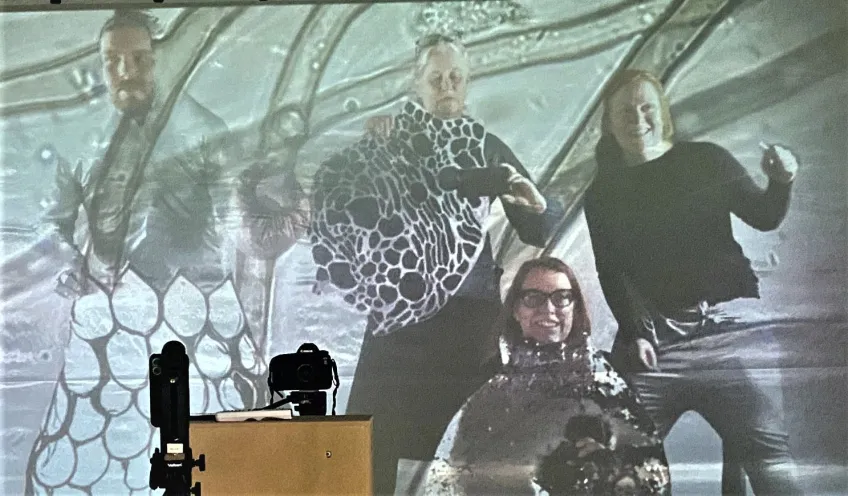
The film material is published on YouTube, among other places, and will become a central part of artists Janna Holmstedt and Malin Lobell's ongoing work. During an Open Studio event at Färgfabriken in Stockholm, the art gallery's two project rooms became both a studio and a home for the interactive installation, which also functions as a film studio. The installation the audience could literally step into the realm of microbes: wearing specially designed microbe suits in front of a green screen, visitors were projected into the microscopic landscapes of the films. On the screen – which resembles a microscope slide – you could interact with the tiny inhabitants of micro life, something that Janna says was appreciated by visitors:
–There were funny, exciting and strange situations. Groups of children who visited us got to meet amoebas and were chased by wheel animals, among other things.
During the Open Studio, the researchers and artists worked together in trying to understand and imitate the different movement patterns of the organisms. Although the researchers have spent much time studying microorganisms under a microscope, something new emerges when they could also play with perspectives and ‘feel’ their way into the world of micro-life.
–You can compare it to the feeling that astronauts convey with their images of Earth from space, how everything is connected. The difference is that here we are thrown into the soil instead of into space, and we see how everything fits together, says Edith Hammer.
Now, the material and ideas gathered during Open Studio will be reworked into an exhibition entitled The Subterranean Carnival, episode 2. The exhibition will open on 18 April during Culture Night in Stockholm – there will be chlorophyll bar, live music and the opportunity to dance with microbes – with the hope that the journey will then continue to Lund later this year.
About the project
Full title
Fönster till underjorden – vägar till bättre förståelse och värdesättning av ekosystemet jord
Research funders
Formas: The Swedish Research Council for Environment, Agricultural Sciences and Spatial Planning.
The strategic research area BECC: Biodiversity and Ecosystem Services in a Changing Climate.
Participants
- Edith Hammer, Senior lecturer, Department of Biology at Lund University.
- Fredrik Klinghammer, Research assistant, Department of Biology at Lund University.
- Kristin Aleklett, Researcher, Department of Biology at Lund University.
- Janna Holmstedt, Researcher and Artist, (p)Art of the Biomass.
- Malin Lobell, Artist, (p)Art of the Biomass.
- Therese Ek, Communications officer, BECC, Lund University